
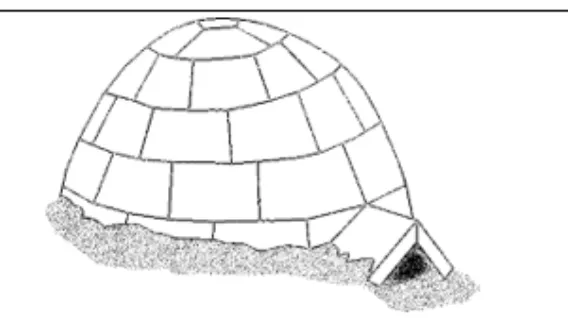
 The Inuit people of the arctic regions of North America typically have winter and summer homes. The summer dwelling is a caribou-hide tent. In winter, in regions of unrelenting cold and endless snow, it is the snow itself that furnishes thermal insulation and shelter.
For economy, simplicity, and speed of construction, the igloo may never be matched. Two people can build one in an hour, complete with skylight, using no tool other than a simple bone knife. But there is a skill to it.
Not far from prime seal-hunting grounds, Inuit people pick a clear, level spot on the frozen snow and lay out a circle ten to fifteen feet in diameter (about three to five meters). Then they carve blocks of snow from within the circle and lay them around the perimeter in an upward spiral, thus excavating and raising the walls at the same time. They pile up these snow blocks in narrowing circles until they have formed a hemisphere, with an opening left at ground level for access and another near the top.
In the higher of the two openings they put a piece of clear ice to serve as a window or a skylight. This last piece is a little harder to find, so it’s not uncommon for an Inuit family to carry around a choice piece of ice for several weeks before igloo-building time.
Once the snow-block beehive is up, the Inuit pack every crack with loose snow. Then one of them crawls through the door opening—which is designed to be just large enough for a person but too narrow for, say, a polar bear—and lights a blubber lamp inside. Feeding the lamp constantly with whale oil or seal blubber, they get a small fire started, then seal the entrance and build the fire higher.
It isn’t long before the entire igloo softens and begins to melt. Because of its hemispheric contour, the water runs down the walls instead of dripping. When the entire structure is damp, the Inuit open the entrance, and the cold blast of arctic air freezes the walls and welds the structure so solidly that nothing short of the spring thaw can damage it.