
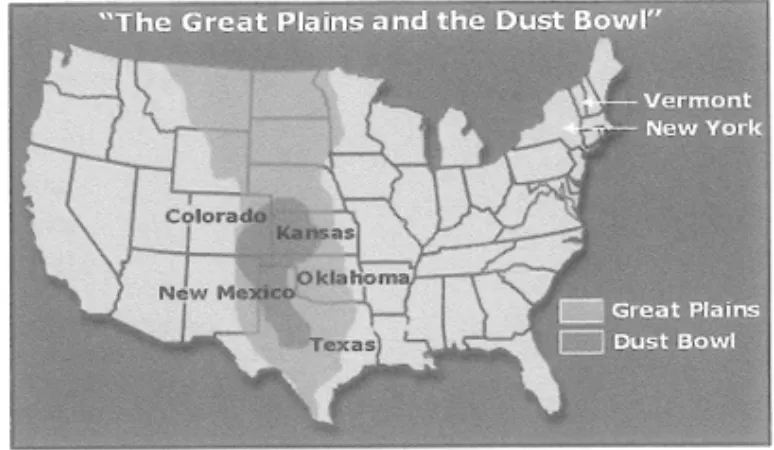
During a span of dry years in the 1930s, large dust storms plagued the Great Plains in the United States. Because of the size and severity of these storms, the region came to be called the Dust Bowl, and the time period came to be called the Dirty Thirties. The heart of the Dust Bowl consisted of nearly 100 million acres along parts of the Texas-Oklahoma border. It also included adjacent parts of Colorado, New Mexico, and Kansas. At times dust storms were so severe that they were called black blizzards and black rollers, because visibility was reduced to only a few feet. Examples of storms that lasted for hours and stripped huge volumes of topsoil from the land are numerous.
In the spring of 1934, a windstorm that lasted for a day and a half created an enormous dust cloud that extended for 2,000 kilometers. As the sediment moved east, "muddy rains" were experienced in New York, and "black snows" in Vermont. Less than a year later, another storm carried dust upward more than 3 kilometers into the atmosphere and transported it 3,000 kilometers from its source in Colorado to create twilight conditions in the middle of the day in parts of New England and New York.
What caused the Dust Bowl? Clearly, the fact that portions of the Great Plains experience some of North America's strongest winds was important. However, it was the expansion of agriculture that set the stage for the disastrous period of soil erosion. Mechanization allowed the rapid transformation of the grass-covered prairies of this semiarid region into farms. Between the 1870s and 1930, the area of cultivation in the region expanded nearly tenfold, from about 10 million acres to more than 100 million acres. As long as precipitation was adequate, the soil remained in place. However, when a prolonged drought struck in the 1930s, the unprotected fields were vulnerable to the wind. The results were severe soil loss, crop failures, and economic hardship.